Seven Thousand Years of Mesopotamian Pottery
From the hand-built vessels of Neolithic farming villages to the glazed polychrome bricks of Nebuchadnezzar's Babylon — how clay and fire traced the arc of the world's first civilizations.
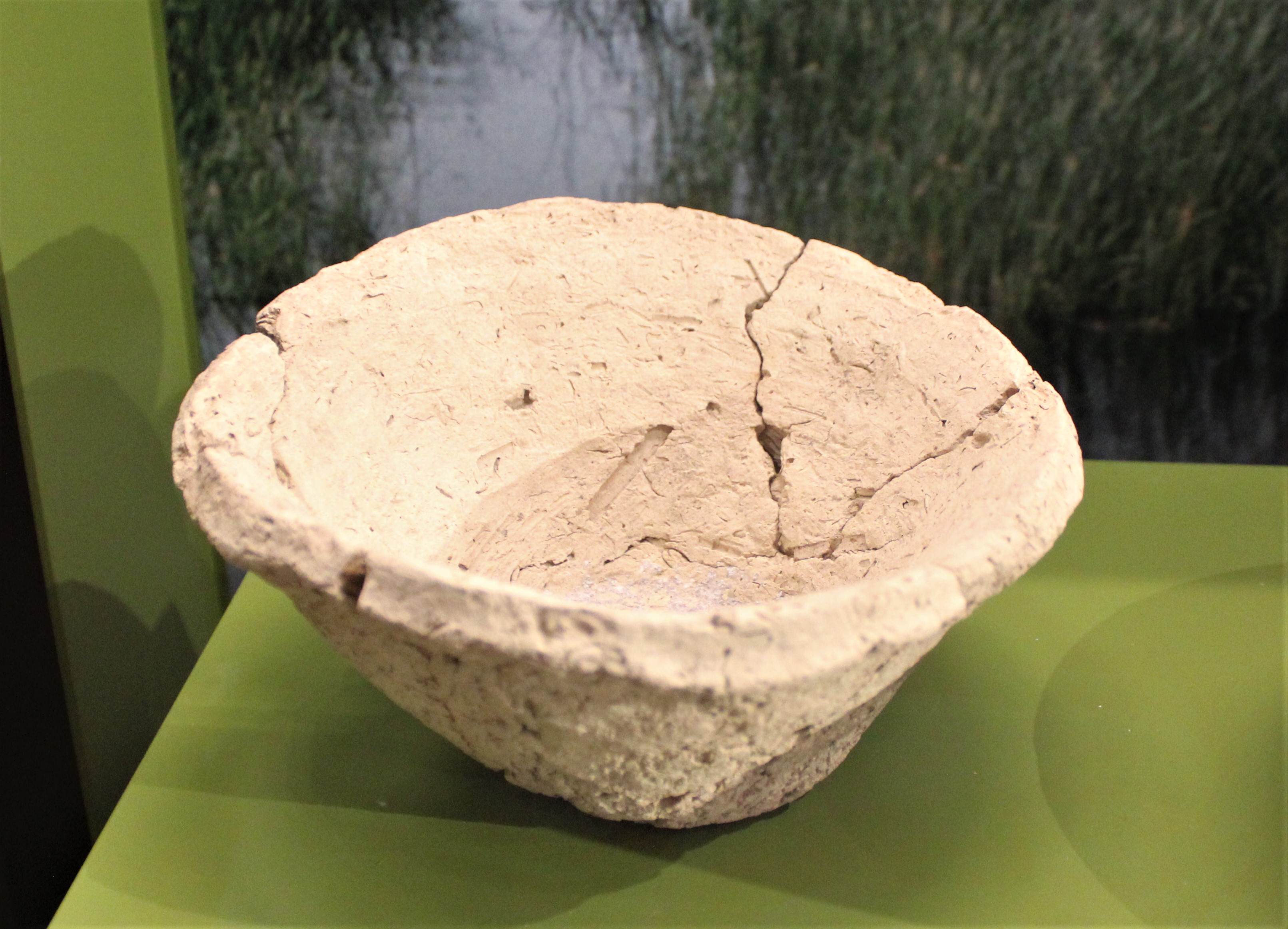
Halaf ware bowl, Tell Arpachiyah, Iraq, 6000–5000 BCE.
British Museum. Public domain via Wikimedia Commons.
Free PDF report: 30 pages · 13 chronological phases · full citations · Chicago Author-Date
Check your inbox — the download link is on its way.
Mesopotamia — from the Greek for "land between rivers" — designates the alluvial plain between the Tigris and Euphrates in what is now Iraq, with northern extensions into Syria and southeastern Turkey. It is here that humanity first built cities, invented writing, and organized the large-scale administration of food, labor, and trade. Pottery was indispensable to all three.
For nearly seven thousand years, from the first Neolithic farming villages of the Hassuna culture through the grandeur of Neo-Babylonian Babylon, Mesopotamian potters worked an evolving tradition: adapting techniques, responding to institutional demands, and encoding in clay a record of every social, economic, and political transformation the region underwent.
Geographic range of the Uruk period culture, c. 4200–3100 BCE. Sites discussed in this lecture are concentrated in the core alluvial plain and northern highlands. Wikimedia Commons, CC0.
Tell Hassuna, Yarim Tepe I (northern Iraq)
Hand-built, coil-formed vessels with incised lines and painted geometric designs on cream slip. Chaff-tempered. Pit kilns or open firing.
Northern Mesopotamia Neolithic Chaff temper
Tell es-Sawwan, Samarra (Iraq)
Fine levigated clay. Radial compositions of fish, birds, and dancing figures in brown on buff. Among the first widespread uniform pottery styles in the Near East. Tournette-assisted production.
Figural decoration Tournette Prestige ware
Tell Arpachiyah, Chagar Bazar, Tell Halaf (Iraq/Syria/Turkey)
Polychrome painted (black, red, white on buff). Rosettes, bucrania, birds, geometric metopes. Tholos kilns reaching 800–900°C. Burnished surfaces sometimes approach accidental glaze. Traded as a prestige good — NAA confirms inter-site movement.
Polychrome Tholos kiln 800–900°C firing NAA-confirmed tradeEridu, al-Ubaid, Ur, Tepe Gawra (Iraq)
Black-on-buff painted geometric designs. Chaff and mineral temper. Slow wheel (tournette). Found at 60+ sites along the Arabian Gulf — the world's earliest maritime trade in pottery. Over 22,000 sherds at Bahra 1, Kuwait.
Maritime trade 60+ Gulf sites Slow wheelUruk/Warka, Susa, Tell Brak, Nippur
Beveled Rim Bowls constitute ~75% of all ceramics. Porous vegetable-tempered clay, fired at only 500–650°C. Mold-formed; undecorated. 2022 residue analysis found animal fats — meat stews, not just grain rations (Perruchini et al., JASREP). Fast wheel develops.
BRBs = 75% of assemblage 500–650°C Administrative wareJemdet Nasr, Kish, Ur
Polychrome painted decoration revives. Reserved-slip technique. Geometric and animal motifs. Found concentrated in administrative buildings alongside earliest cuneiform tablets. Transitional to Early Dynastic I.
Polychrome revival Elite/admin context Early writing
Ur, Kish, Nippur, Khafajah (Diyala Valley)
Scarlet Ware: polychrome haematite-red and black on buff. Animal friezes and geometric bands. Royal Cemetery at Ur: 2,000+ burials; pottery type directly encodes social status. Delougaz 1952 (OIP 63) is the foundational typology.
Scarlet Ware Royal Cemetery Ur Status markingAgade, Nippur, Susa
Continued standardization. Metallic-surface wares (burnished grey/silver sheen mimicking metal vessels) signal that prestige is migrating to bronze. Reduced painted decoration. The first multi-ethnic empire's administrative needs drive ceramic uniformity.
Metallic wares Standardization First empireUr, Nippur, Girsu, Lagash
Highly centralized redistributive economy. Ration bowls dominate. Pottery reaches its lowest aesthetic ambition since Hassuna — not for lack of skill, but by institutional design. Over 120,000 administrative tablets document the ration system these pots served.
Ration bowls Administrative economy Functional minimumBabylon, Nippur, Isin, Larsa
Modest revival of painted decoration. Distinctive carinated bowls (sharp angular break in the body profile) become reliable chronological markers. Goblet forms proliferate. Armstrong & Gasche (Oriental Institute) provide the comprehensive ceramic guide.
Carinated bowls Decoration revival Hammurabi's eraBabylon, Dur-Kurigalzu, Tell Khaiber
Painted wares decline sharply on everyday pottery. But Kassite craftsmen develop molded glazed brick technology — the forerunner of the Neo-Babylonian Ishtar Gate. Ceramic investment moves from the vessel scale to the architectural scale.
Glazed brick Architectural ceramics Vessel decline
Nineveh, Nimrud, Assur
Glazed tile programs on palace walls; domestic pottery remains utilitarian. Assyrian palace reliefs were originally painted — glazed architectural ceramics complement them. Strong regional continuity in everyday vessel forms.
Glazed palace tiles Utilitarian continuityBabylon, Nippur, Borsippa (Nebuchadnezzar II, 604–562 BCE)
The Ishtar Gate: glazed polychrome bricks in brilliant lapis-blue with relief dragons, lions, and bulls. Technical mastery of color chemistry across thousands of standardized bricks — the apex of Mesopotamian ceramic technology, expressed at architectural scale.
Ishtar Gate Polychrome glaze Technical summit
The oldest known dedicated pottery kiln in Mesopotamia dates to approximately 6000 BCE, discovered at Yarim Tepe in northern Iraq.[12] This two-chamber updraft design — combustion below, firing above — predates the fast potter's wheel by roughly two thousand years.
Halaf-period tholos kilns (beehive-shaped) allowed reducing atmospheres and estimated temperatures of 800–900°C, producing the burnished, near-glazed surfaces characteristic of Halaf fine ware. By contrast, Uruk Beveled Rim Bowls were fired at only 500–650°C — a deliberate trade-off: cheaper, faster, adequate for purpose.
The Neo-Babylonian period saw kiln technology reach its Mesopotamian apex: precise atmospheric control enabling consistent polychrome glazes across thousands of architectural bricks.
Wheel technology in Mesopotamia developed in three stages. The tournette (slow wheel, a manually-rotated platform) appears in the Ubaid period, c. 5500 BCE, assisting in the symmetrical finishing of hand-built forms.
The fast wheel — operating on the flywheel principle, with angular momentum stored in a heavy rotating stone — emerges by the late Uruk or early Early Dynastic period, enabling thrown vessels of unprecedented thinness and symmetry.
Baldi's 2021 study in IANSA challenges the assumption of uniform adoption: wheel use in the Uruk world developed in a "widespread and discontinuous way." Beveled Rim Bowls themselves may have been mold-formed, not wheel-thrown at all.[2]
Mesopotamian pottery improved along the dimension of technical capability — measurably and unambiguously, from Neolithic pit-firing to Neo-Babylonian polychrome glaze chemistry. But aesthetic complexity at the vessel scale followed an inverted-U curve, with the Halaf period as the apex. Functional efficiency peaked in the Uruk period. In each era of apparent "regression," ceramic investment was redirected — to architecture, to administration, to other prestige materials — rather than lost. The evolution was not linear. It was multi-dimensional.
Neutron Activation Analysis (NAA) of Halaf pottery from the Khabur Headwaters region demonstrates that decorated painted ware was traded across significant distances — vessel clay compositions don't match local sources at receiving sites.
NAA 24 trace elements analyzed per sherd · Davidson & McKerrell, Iraq 1976Ubaid-type pottery appears at over 60 sites along the Arabian Gulf coast. Bahra 1, Kuwait (excavated 2009–2023) yielded the largest known assemblage: over 22,000 sherds, including Coarse Red Ware comprising 47% of the total (n = 10,742). Geochemistry confirms the Ubaid Ware was imported from Mesopotamia.
22,000+ Potsherds, Bahra 1, Kuwait · Earliest maritime pottery trade in the worldAssociated with the Ubaid Gulf network: the oldest known sea-going boat remains in the world, recovered from Ubaid-period deposits in Kuwait. Pottery distribution provides the evidence base for reconstructing an entire maritime exchange system driven by status and ceremony.
5th mill. BCE Earliest documented long-distance maritime pottery trade · Antiquity, Cambridge CoreBackground: Halaf culture pottery distribution map, c. 5200–4500 BCE. Wikimedia Commons.
Seven questions directly motivated by gaps and tensions in the existing scholarship. Each represents a tractable research program — not speculation, but a missing experiment or analysis. Click to expand.
1978.
"Beveled Rim Bowls and Their Implications for Change and Economic Organization in the Later Fourth Millennium B.C."
Journal of Near Eastern Studies 37 (4): 289–313.
doi:10.1086/372668
2021.
"How the Uruk Potters Used the Wheel: New Data on Modalities and Conditions of Emergence of the Potter's Wheel in the Uruk World."
Interdisciplinaria Archaeologica Natural Sciences in Archaeology 12 (2).
doi:10.24916/iansa.2021.2.6
2010.
Beyond the Ubaid: Transformation and Integration in the Late Prehistoric Societies of the Middle East.
Studies in Ancient Oriental Civilizations 63. Chicago: Oriental Institute.
Free PDF (Oriental Institute)
1976.
"Pottery Analysis and Halaf Period Trade in the Khabur Headwaters Region."
Iraq 38: 45–56.
doi:10.2307/4200052
1952.
Pottery from the Diyala Region.
Oriental Institute Publications 63. Chicago: University of Chicago Press.
Free PDF (Oriental Institute)
2022.
"There and Back Again: Local Institutions, an Uruk Expansion and the Rejection of Centralisation in the Sirwan/Upper Diyala Region."
Antiquity 96 (388): 914–931.
doi:10.15184/aqy.2022.94
1935.
"Excavations at Tall Arpachiyah, 1933."
Iraq 2 (1): 1–178.
doi:10.2307/4199568
1994. Ancient Mesopotamian Materials and Industries: The Archaeological Evidence. Oxford: Clarendon Press.
2022.
"Revealing Invisible Stews: New Results of Organic Residue Analyses of Beveled Rim Bowls from the Late Chalcolithic Site of Shakhi Kora, Kurdistan Region of Iraq."
Journal of Archaeological Science: Reports 46.
doi:10.1016/j.jasrep.2022.103730
1999. Ancient Mesopotamia: The Eden that Never Was. Cambridge: Cambridge University Press.
Iraq. Cambridge Core.
cambridge.org/core/journals/iraq
1934. Ur Excavations, Vol. II: The Royal Cemetery. London: British Museum and University of Pennsylvania Museum.
Heilbrunn Timeline of Art History: Mesopotamia chronological essays.
metmuseum.org/toah · Open Access (CC0)
Open-access publications including OIP 63 and SAOC 63.
isac.uchicago.edu/research/publications
Pottery and Social Power
The Royal Cemetery at Ur
Excavated by Leonard Woolley between 1922 and 1934, the Royal Cemetery at Ur contains more than 2,000 burials spanning the Early Dynastic period. Pottery type, quality, and quantity correlate directly with burial wealth: elite graves contain fine wheel-thrown vessels in standardized assemblages; commoner graves contain fewer, coarser pieces.
The "death pits" associated with the richest tombs — including that of Queen Puabi (PG 800) — contain large vessels holding food and drink for the afterlife, alongside the remains of retainers sacrificed to accompany the deceased. Pottery here is both social marker and ritual participant.[14]
Başur Höyük: Early State Formation
The Early Bronze Age cemetery at Başur Höyük in southeastern Turkey (c. 3000 BCE) provides some of the earliest evidence of lineage-based hereditary elite status in the Mesopotamian world. Large stone-lined cist tombs contain retainer burials alongside lavish metal wealth. Ninevite 5 pottery vessels — a northern Mesopotamian painted tradition — are arranged in the elite tombs in ways that clearly mark rank.[6]
Intriguingly, teenagers occupy the richest tombs, confirming that status was inherited, not earned — one of the clearest early signals of the stratified social order that would characterize Mesopotamian civilization for the next three thousand years.
Specialized Kilns and Craft Control
Dedicated pottery production sites — separate from domestic settlements — indicate that ceramic manufacture was, in some periods, controlled by distinct social groups under institutional patronage. Kiln sites at al-Ubaid and Eridu in the Ubaid period, and the exclusively production-focused site at Kall Karim in western Iran (Ubaid 2–3), show that specialized craft production was an early feature of Mesopotamian social organization.[11]
This specialization implies both elite patronage of craft and institutional control over the supply of standardized vessels — two sides of the same social coin.
Halaf ware bowl, Tell Arpachiyah, Iraq, 6000–5000 BCE.
British Museum. CC0.